AI export controls debate rages as Trump, Xi meet
Democrats pressure president in his dealings with the Chinese leader
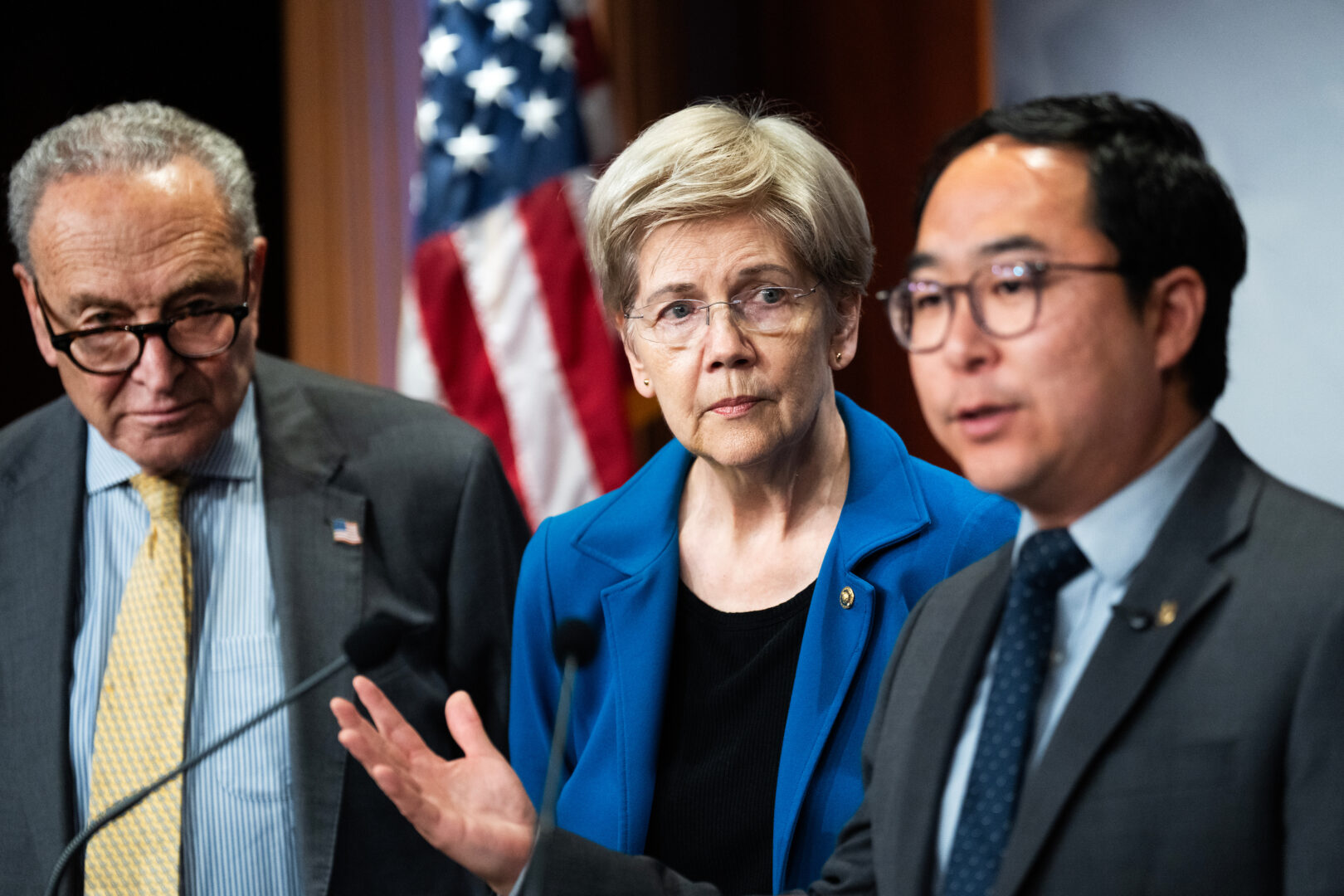
Senate Democrats are using Chinese leader Xi Jinping’s high-profile state visit to Washington this week to press Republicans for votes on export control legislation restricting Beijing’s access to advanced chips used in artificial intelligence technology.
The bills in question have bipartisan support, and Republicans agreed to include them in a giant manager’s amendment to the must-pass annual defense authorization bill. But with that broader bill stuck until after the elections, Democrats sought to highlight the issue as a means of putting pressure on President Donald Trump in his dealings with Xi.
“President Trump must draw a hard line,” Senate Minority Leader Charles E. Schumer said at a news conference Wednesday, adding that the president “could take action today” to keep advanced AI software and hardware out of China’s hands.
“Trump is the very first president who has negotiated away our export controls, our national security, to the Chinese,” Schumer, D-N.Y., said. “Put simply, Trump is handing China the technology it needs to win the AI race.”
Fine line
Trump’s second term has been marked by hard-line tactics in dealing with China economically and militarily. But on sensitive advanced computer chips, the administration has tried to walk a fine line between national security interests and asserting U.S. dominance in the global AI market.
Trump has cultivated a personal relationship with Nvidia Corp. CEO Jensen Huang, for instance, and his administration has loosened export controls in some cases, enabling Nvidia as well as Advanced Micro Devices Inc. to sell certain chips in China.
By the same token, advanced chips have found their way to China around U.S. export controls through third countries, activities the Trump administration has tried to shut down in the case of Nvidia’s more sophisticated B200 chips.
Senate Banking ranking member Elizabeth Warren has taken direct aim at Nvidia and Huang himself in the past, alleging the chipmaker is too eager to sell to the Chinese.
Warren, D-Mass., said at the news conference that AI export policy should be set through legislation rather than determined by talks between the Trump administration and China with Big Tech CEOs at the table.
“We certainly should not be letting tech billionaires like Nvidia’s Jensen Huang negotiate away our export controls or decide our AI policy to benefit his own personal bottom line,” Warren said. “Mr. Huang should be nowhere near the negotiating table during President Xi’s visit.”
An Nvidia spokesperson wasn’t immediately available for comment. But the company has said previously that the Chinese military hasn’t bought its chips, and that licenses granted in May for the sale of older H200 processors haven’t generated much interest.
In the second quarter of this year, Nvidia reported that less than 1 percent of its data center revenue came from H200 sales in China.
The Biden administration also allowed Nvidia to sell certain chips in China, and the White House on Wednesday pushed back on Schumer’s characterization of Trump being weak on export controls.
“These same Democrats stood idly by and twiddled their thumbs when the Biden administration freely let critical technologies flow overseas,” White House spokesperson Kush Desai wrote in an emailed statement. “The Trump administration has implemented the most rigorous export control regime in modern history, and remains committed to America’s national and economic security.”
Industry groups representing major AI companies and suppliers — with the notable exception of Anthropic, Axios reported — are lobbying hard against legislation the Senate Democrats pushed Wednesday, arguing the bills would stifle innovation and hand over AI supremacy to competitors.
The Chinese government has also taken issue with these and similar measures, arguing in a statement earlier this year that they “would severely undermine the international economic and trade order and disrupt the stability of the global semiconductor industrial and supply chains.”
Bill details
One of the bills, introduced by Sen. Tom Cotton, R-Ark., with strong support on both sides of the aisle, would require location tracking mechanisms on advanced chips and notification by exporters if their product has been diverted from its intended location or subject to tampering.
The House Foreign Affairs Committee reported out a similar version in March on a 42-0 vote, and Senate Armed Services Chairman Roger Wicker, R-Miss., agreed to include the Cotton bill in the sprawling managers amendment to the fiscal 2027 national defense authorization act, or NDAA.
Industry groups led by the Information Technology Industry Council — which counts Nvidia, AMD, OpenAI, Google and many more among its members — wrote to congressional leaders this month urging them to keep the bill out of the NDAA.
“Merely creating the impression of deepening U.S. government control over American technology is harmful,” they wrote, arguing the Cotton bill “would directly undermine American diplomatic engagement by reinforcing the perception that U.S. products and services cannot be trusted.”
Another bill wrapped up in the NDAA is led by Sen. Pete Ricketts, R-Neb., who introduced it along with Schumer, Jim Risch, R-Idaho, and Andy Kim, D-N.J.
It would require the Commerce and State departments to work with allied suppliers of semiconductor manufacturing equipment to implement export controls or license requirements to prevent the equipment from going to semiconductor manufacturers in adversarial nations.
If allied countries didn’t implement the export controls, they would be subject to U.S. export controls and licensing requirements for their own firms’ semiconductor manufacturing equipment.
The Dutch government has objected to the bill on behalf of ASML, which supplies deep ultraviolet lithography equipment for integrated circuits used in AI chips. And U.S. industry argued in the Sept. 3 letter that the measure would undermine diplomatic relations and partnerships with firms abroad by codifying government controls on U.S. equipment.
The House Foreign Affairs Committee approved a similar version, 36-8, in April.
A third bill Democrats highlighted Wednesday was introduced by Sen. Jim Banks, R-Ind., with backing from Warren, Ricketts, Cotton and several others on both sides of the aisle.
It would codify Trump’s ban on sales of the most powerful AI chips to foreign adversaries for 18 months; require the Commerce Department to certify that advanced chip exports won’t undermine U.S. supply or end up used for military or intelligence-gathering purposes; and require export licenses for sales to “countries of concern.”
The House Foreign Affairs panel approved a similar version on a 42-2 vote in January, soon after the Trump administration authorized Nvidia’s H200 exports to China.
The Banks measure would “set a dangerous precedent by regulating specific technologies in statute, undermining the competitiveness of U.S. technology exports in global markets,” the industry groups wrote. The bill “seeks to make Congress the final arbiter of export control decisions,” which would “undermine the perceived reliability of American companies.”
NDAA blockade
The NDAA typically passes every year. Senate Republicans sought to bring it up in July, which would have enabled the managers’ package to be included and the bill debated and eventually passed.
Senate Democrats blocked the NDAA due to concerns over the Iran war and the Trump administration’s $1.5 trillion Pentagon spending request, however.
At Wednesday’s news conference, Schumer did not directly answer about whether the Democrats’ opposition to the NDAA also is holding up the export control bills.
“If [Senate Majority Leader John Thune, R-S.D.] would put them on the floor today, we can pass them. Period,” Schumer said.
Allison Mollenkamp and Peter Cohn contributed to this report.